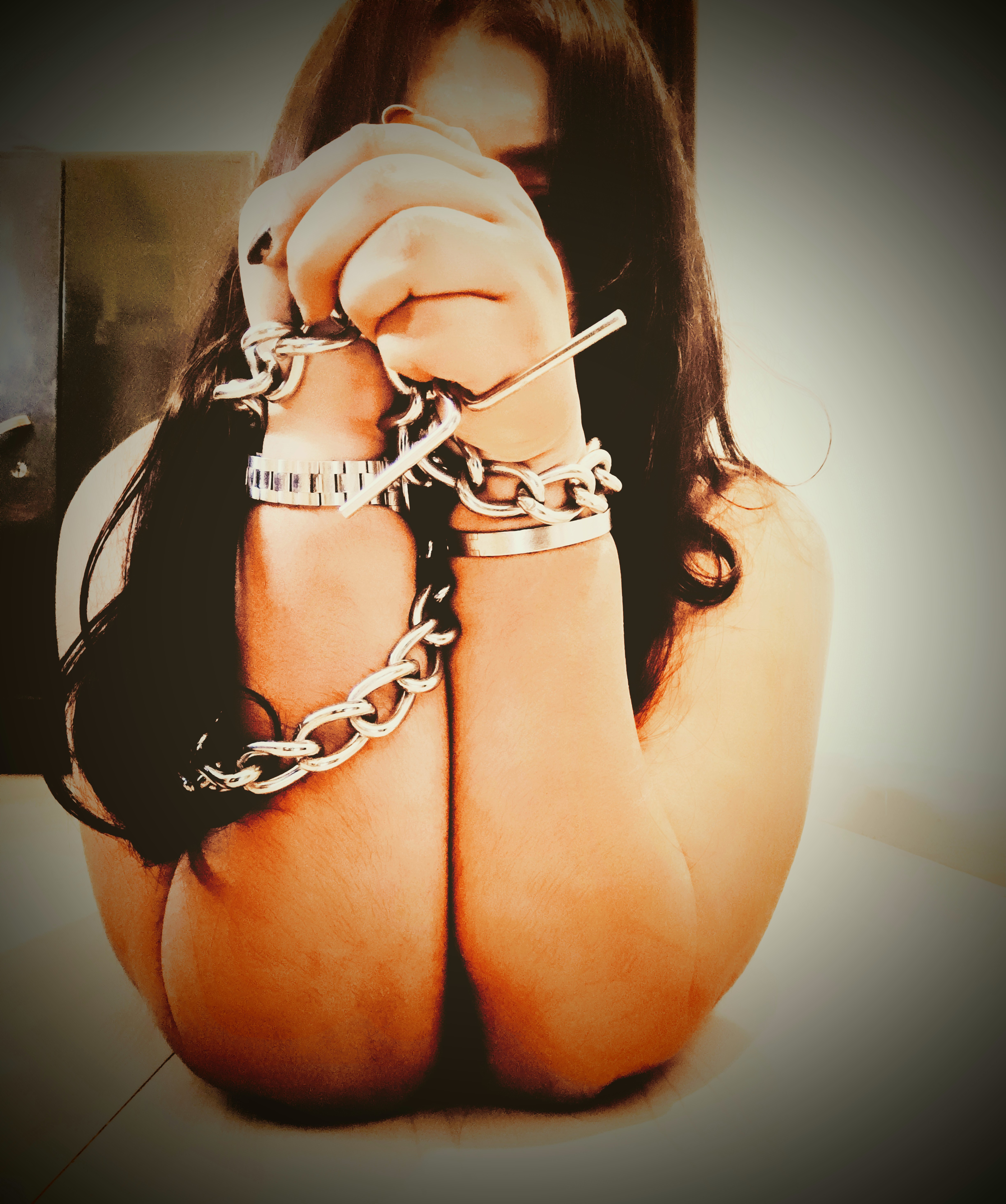
One of the primary conceits of my relationship dynamics is that I surrender the right to say no. You can call that Consensual Non-Consent (CNC) or you could call it Total Power Exchange (TPE), I don’t really care what terminology we use so long as what I mean is clearly understood. Here’s what I mean: I do *say* the word no from time-to-time but it doesn’t have to mean anything to my partner, I give my consent for them to ignore it. Even if I don’t like what they are asking me to do or doing to me, I’ll do it or take it. Even if I want to stop and they don’t, it’s fine to continue. If they take issue with the mere utterance of the word no or any form of resistance, it is within the purview of our relationship dynamics for them to punish me for it (and also, it’s ridiculously fucking hot to be punished for merely, helplessly, reflexively uttering the word no). I consent to accessing or being put into states of suffering, trauma and brokenness. I also want to state, clearly, that this kind of thing is only practised by me in long-term relationships and never in casual or pick up play.
The thing we must accept about a relationship like this is that you are consenting to the possibility of not only being traumatized but also having your emotional and mental states possibly altered or transformed in the long term. There are things about you that will *change* and I don’t mean that in the “growth, comprehension, values” way alone, I mean it in a much more physical sense, your body will be altered by this (in the long-term). Your reactions to things may change, you may get injured, your reflexes may change, your preservation-mechanisms may erode, your physical response to fear may be altered. However, none of this means that the mere act of consenting to a relationship of this style precludes abuse or violation. We’ve all heard this reasoning, right? It is frequently offered when someone in a relationship like this one claims they were abused within it. All of a sudden all the lurkers on the internet come alive to loudly proclaim: *She couldn’t have been abused, she consented to being abused.* (Sorry, did I say she? Mea culpa, parapraxis). It’s not so simple and had it been so simple every moron would be able to successfully navigate this dynamic and we would never read or write long-ass posts about it.
I’ve been in two long-term relationships of this nature. The first one lasted nine years and the second is in its eighth (don’t do the math, it gets *troubling*). The first one, with a man, let’s call him A, was abusive at its core. The second one, with a man, let’s call him R, is not. How do I know that? It’s not my gut, guts are for digestion, it’s because from this vantage point, I can see the differences in these relationships and evaluate which aspects of the first made it abusive. Those are my credentials, I suppose, I state them so that you can accept or qualify everything I say based on them, I am not an “expert” and I am not sure how one would become an expert on this front, I speak merely from personal experience and a lifelong addiction to deduction. Please do not take my words to be worth more or less than they are, they are a perspective that is completely non-prescriptive but could serve as guidance if you seek that sort of thing. In that light, the following are things I consider, would consider, have considered when determining abuse/violation from CNC/TPE and developing a healthier dynamic of fuck-uppery:
**So you have given up your right to say no, but how do they react when you do say it?**
It made A extremely angry whenever I said the word no. He never wanted to know why I said it and even in states of extreme pain or revelry when it was uttered reflexively, and did not in any way ask to noted, he got angry. In that anger, he was not just violent, but he reacted by removing himself emotionally from our relationship. It happened instantly and lasted for days, and in those days he behaved like he wouldn’t care if I stayed or left. Lived or died. I hadn’t just betrayed the condition he placed on me, but our very relationship. It’s on you if you want to place this condition at the heart of your relationship (and maybe you have a better method that I have ever found of enforcing it and still keeping yourself safe), but for me, the act of resistance needs to not carry emotional consequences of the kind that bleed outside of the dynamic. A once punished me for saying no by not showing up to a trip I had planned for us. He told me he got on the plane and when I got there, he wasn’t there and he wasn’t coming. He told me he wanted me to feel how I had made him feel by resisting him. If you feel inclined to say that is okay because I consented to *everything*, you may want to consider why you are grasping at straws.
On the other hand, R investigates every single no. He may not pay heed to them, but he always wants to know from where my resistance is coming, and he modifies his behaviour accordingly if that is what he feels is required. If I say no because it was a reflexive act of fear, I will get whacked in the face twice as hard but if I say no because something that happened is causing me to have an anxious reaction, he will modify what he is doing accordingly. Ultimately the decision to stop or not is still on him, but knowing that I am heard makes a huge difference and while we are on that note…
**…I may surrender the right to say no but I didn’t surrender the right to say** *all the other words*.
There is a peculiar tendency in the kink community wherein we believe that not having a safeword means you have no words at all. You have words, use them. This is what communication means. Communication doesn’t have to stop because you don’t have a safeword. I don’t need to tell R, nor did I ever really need to tell A, when things were in a place where I couldn’t survive anymore. They both know/knew me well enough because I insisted on talking about every single thing I experience in excruciating detail and perpetuity, I insist on explaining every reaction I have, investigating every decision they make, and because of that I know that when R stops and A didn’t, it wasn’t for lack of awareness of the situation. It wasn’t because one knew what was happening and the other didn’t. They both knew and A chose not to stop or to pursue a damaging path because he wanted to damage me, not because he misunderstood. Communication clears up the ambiguity around intent, and making that the goal makes you communicate better. The more you communicate, the less likely it is that “misunderstandings” will occur. They may still occur because you will change, they will change, the circumstances will change but there is a fix for that.
**You will not be able to successfully negotiate every single possible outcome but you can negotiate what you will do if an unforeseen possibility presents itself.**
It’s the truth that you won’t be able to foresee everything. It’s often presented as an excuse, in that one may fuck you over and then say, *’but we cannot possibly negotiate everything*’ and it’s true, you cannot because it’s like trying to postulate every version of a chess game before you sit down to play. However you can negotiate how it will be handled when you do find yourself in an unforeseen state. For example, if your partner wants to do something new that they don’t know your feelings about, you can decide in advance that they should talk to you about it first even if they retain the decision making power on it. A did not want to do this at all. He said it made him feel micro-managed, as if he didn’t have *real* control in this relationship and I realised that if your safety is inversely proportional to their feeling of being in control, there may be more than sexual fetishism at play. We all bring the entirety of ourselves to these things, and that includes the things that are wrong with us. Which brings me to something that I feel isn’t sufficiently discussed…
**The rigid and pedantic adherence to the conditions of the construct, who is it for?**
As far as A was concerned anything that even slightly questioned the condition of my total and complete subservience and fealty, made him unhappy. It didn’t just impact his sexual pleasure, it impacted his mood, like a song that is stuck in your head, a financial worry that you are fielding or a fly in your car. He couldn’t discuss the prospect of my safety or how he would react to his mistakes because for him that wasn’t the draw. He needed me to behave and be a victim to him, and the precautions around safety ruined that, that was where his sexual pleasure truly lay and as did the only way he could be happy in a relationship. He didn’t need a masochistic slave, he needed rehabilitation and possibly incarceration. The fact that he went on from me to date a conservative younger woman whom he married before he started to outrightly abuse, not even attempting to bury it under the garb of BDSM this time, confirms my theory about him. He is not a sadistic master, he is a misogynistic predator. The rigid adherence in his case was about the fact that my agency undermined what he truly wanted from me.
There are other kinds of rigid adherence that I have seen around me that I find problematic as well. For instance, if you do TPE or CNC to be edgy, you are likely not thinking about what you are doing enough to do it well, and in your need to be edgy, you will hurt yourself and someone else. If you just want to do scene-based rape-play or a little coercion, it’s okay to just do that without diving head-first into the abyss. You don’t have to check everything off a list, you can make your own list and that is perfectly acceptable because, shockingly, you and your partner are the only people in your relationship, and there’s no CNC-police coming to check if you are doing it completely. All or nothing is dumb as fuck, because it either means you are doing more than you want to do or less, and what exactly is the upside in no one getting what they want?
The thing I appreciate most about R is that he gives no shits about how things are “supposed to look”. If he wants to make me my damn coffee every single day, the world of mastery can fuck itself, he is doing it. As it is governing all your interactions with a person from a single point on the graph of your relations is moronic, but doing it in a way that you don’t even get what you want so long as you get to do things in the way that they look “right” is the most moronic. It’s like trying to recreate porn or rom-coms. The conditions of your dynamic have to work for *you* and re-negotiating them when they stop working for either party is the smart thing to do.
**Which is why the most important conversation you will ever have with your partner in terms of developing or managing this dynamic is: What do you get out of it and what do you want from it?**
Oh, I don’t mean make a list of rules or fetishes, not at all, I mean, why does this appeal to you at all? Why do you want a partner who cannot say no to you? Why do I want one to whom I am completely beholden? Why do you want to undermine my will? Why do I want my will undermined? Why do you want to hurt me to the point of suffering? Why do I want to play with my trauma instead of a dildo? How did your pleasure come to be tied to this condition of power exchange?
I ask these questions for several reasons. The first and the simplest reason is that if you haven’t thought about it (and that’s instantly apparent), in my book, you aren’t ready or safe. This, usually, eliminates 90% of the people who say they want this. The other reason is that there are some reasons that are disqualifying to me. For instance, any gender-based reason is unacceptable to me. If you think that women should be subservient and men should always be in a dominant role and that is what romance means to you, sorry, I’m hella out. That’s just my disqualifying reason, mine doesn’t have to be yours, but you should know yours. The biggest reason why I want to have this discussion is because, well, I need to know you to know whether we will interact well together, and telling me that you’re really into whips doesn’t actually tell me anything. I need to know our sexual ideologies align sufficiently for us to do well together. It’s like..say I am super into doing my nails for you because I enjoy this enforcement of femininity like I would enjoy a gilded cage in which I am forced to wear ideals of beauty I despise in service to another and you really are into this pretty feminine girl thing because you think the beauty of women lies in their conformity to gendered ideals of aestheticism, that’s much less comparability than meets the eye, but it could easily seem like compatibility if we don’t ask why. I want to dig that deep because that’s the realm in which our sexualities will interact. That’s the realm in which my pleasure resides. And if you aren’t able to dig deep, we’re not doing the same thing. Which is also why, it’s important to ask….
**Were there any hidden conditions to this dynamic?**
A was all about loopholes and hidden conditions. While I still agree that you cannot negotiate everything, he was into the kind of negotiation where he was deliberately trying to keep me from considering certain aspects so he could exploit them later. Once I had consented to being his slave, he suddenly brought forth this barrage of expectations of which he had said nothing while we were still discussing things. It’s not that they didn’t occur to him, it’s that he wanted to acquire my consent in incomplete circumstances *on purpose*. I think this is the primary way in which predators take advantage of “newbies,” they rely on the fact that there may be questions you do not know to ask and instead of apprising you of those questions for your benefit, they hide them for their benefit. If they claim to be “experienced” and they use that experience as a badge of honour instead of using it to demonstrate better, more nuanced behaviour, be suspect. Doing something for many years doesn’t make you good at it without the intention of getting better or being open to learning, plenty of people operate solely out of a confirmation bias.
There are absolutely no hidden conditions to the dynamic between R and I, and when things come up that haven’t been previously considered, we talk about them. That doesn’t “ruin the fun” for him. The element of surprise is not undermined by not bringing me closer to death than I need to be. And I must admit, a big part of this was the power equation between us as we negotiated this dynamic and you should ask..
**What was the power equation between you at the time of negotiation?**
A was older than me. He was more experienced. I was (TOU) young. Apart from that last one, there is nothing inherently wrong with those things, but the awareness of a power imbalance while you are negotiating a dynamic helps you negotiate better. With A, I was negotiating from a place where I had already submitted to him and he was happy to exploit that, with R, it was different.
Look, I’ll be honest about something, the reason it worked so well with R is partly because even though I am in the bottom-role, at the time we met, I was much more experienced than him. I know you cannot manufacture that circumstance and it cannot be the case for everyone, but the fact that it was the case for us had a big part in why I managed to lead this negotiation in a way and how I realised bottom-led negotiation is a wonderful thing, and I will be willing to make a case for why bottom-led negotiation leads to much fewer instances of abuse, violation and mistakes. It is not because bottoms are “smarter,” it’s because we have a more innate and physical assessment of things that could go wrong because more of the threat applies to us. He could make a mistake and have to deal with that, but I could get hurt, you understand? The experience only adds to this in the way that I *have gotten hurt* and that has taught me how to litmus test for certain things.
Essentially though, as you negotiate this dynamic, the primary concern of both parties should be to protect the other and themselves, to cater to whatever power imbalance exists and consider how it may impact the other. And one of the places that manifests within this dynamic is when you do something new.
**So are you doing something new? Will it kill you to be more careful?**
There are many established practices within relationships but every once in a while, even in a “don’t say no” relationship, you will want to do things that are new to one party or both. A always sprung things on me and some things are okay to spring within the context of the relationship, other things shouldn’t be sprung because they may infringe upon other commitments, fulfilling my responsibilities of my professional life. A didn’t give a fuck, if he wanted to break my wrist, the fact that I had a deadline and a week full of work was not something to consider. If he wanted to pull out my fingernails with pliers, the fact that I had never even fathomed such pain wasn’t a good enough reason to discuss the prospect with me.
With R, initially, there were many things that were new to him, which meant that even as the bottom, I had to be more considerate of him. Now, there are sometimes things that are new to both of us, so when we do them, we discuss them a lot, we check in a lot and we communicate during them a lot. In that circumstance, we are perfectly comfortable suspending the dynamic for a bit, because the first time you do something determines how it will go when you do it for the twentieth time and if you traumatize me right off the bat, there likely won’t be a twentieth time. If you want to have a relationship where you can exploit someone’s trauma, you have to invest in it with restraint as well. It’s a marathon, not a sprint. And as far as your training goes, there will be mistakes and…
**Every mistake is not abuse, but the every failure to address it, is.**
This is the most serious litmus test I use. Will there be fuck ups? Come on. We’re human beings. I have written over a million words in my life, I still fuck up the grammar sometimes. It happens. But what do you do afterwards? If you take responsibility, address the issue, develop a protocol to handle it better in the future, focus on helping the healing of the person harmed, diagnose how you came to make the mistake and talk about it honestly and openly, well, excellent. You made a mistake. It happens. But, if you get defensive, refuse to acknowledge the mistake, immediately start building a defence for yourself, find ways to blame the other party, make a case for how blanket consent means you cannot be held responsible for your mistakes, tout your role in order to be immune from questioning, learn nothing from it or refuse you talk about it, I’m more comfortable wondering if you are an abusive person.
Look, I get that we have created a bit of an environment where the only options are perfection or abuse, and I know that keeps a lot of people from sharing things about their relationships that are less than perfect because their mistakes are immediately likened to toxicity, abuse and violation, but seriously, if you want to do things that are “difficult,” step out of that comfort-zone and display some moral courage. Take some heat. If you can do it, you can damn well stand up for it. If you can tout your prowess, you can tout your weakness as well. The better you get at talking about your mistakes, the safer you make the world for *everybody*. (Disclaimer: By mistakes I do not mean abuse or violation, those aren’t mistakes, those are intended). Sometimes, when people are uncomfortable discussing their mistakes or their behaviour within a relationship with other people because they just “won’t understand,” they are also relying on this covenant of silence to brush their bad behaviour under the rug, and that is why it is important to ask…
**Are they using your dynamic as a justification for their bad behaviour?**
Essentially, “I can do anything because I am the Dom.” A was extremely unhappy when I discussed our relationship with anyone, he hated that I existed within the kink “community,” he didn’t want to be a part of it in any way, he didn’t want me writing about him and he didn’t want me to be corrupted by the mainstream ideas of kink that were doing the rounds in the world. In his defence, he was a little bit right about the kink community though he was mostly wrong, but the reason he didn’t want me talking to people was because he had awareness of what he was doing, I didn’t. What I couldn’t see, he knew others would. He knew that he was using our dynamic to justify behaviours that anyone with half a brain who has read anything @SpanishRed has written would immediately question. This is harder to understand than meets the idea, because even in the community we have a tendency to focus on the wrong thing sometimes. Back when I did write about A many people questioned the extent of the violence in our relationship, but that wasn’t the problem, I was genuinely consenting to most of that, they didn’t question the emotional conditions to which he subjected me, and those were the bonds of abuse that kept me in the relationship. So when people did question me, I took that questioning as confirmation of what A said about the kink-community, they were closed-minded because they couldn’t fathom that I could genuinely want that much violence, but I didn’t present a complete picture either. I thought the “relationship” aspects of our relationship were irrelevant to the kink aspects, so why did I need to share them? But the relationship aspects were where the seeds of abuse lay and had I considered them all as a package, I would have been less blind (but not that much less because I am a moron in love). Had I been less blind I would have seen that he used this dynamic to justify things I would never consent to. He wanted control over things I didn’t know I had offered. I didn’t know to ask…
**What you do versus who you are, which one do they want control over?**
It took me a long time to get to this. An embarrassingly long time. I do not wish to subject myself to a personality-transplant. Not for the love of kink, not for the love of pain, not for the love of CNC, not for anything. The reason A wanted control over me was because he did not like who I was and he saw CNC/TPE as a way to change those things about me. He wanted control over who I am as a person. He wanted to enforce how I dress, not to make me feel objectified, but because he didn’t like I how I dressed. He wanted me to be demure, not because he wanted to control my behaviour for his psychological pleasure, but because he didn’t think women should be loud and open like me. He wanted to control who I slept with, not because he wanted me to feel like chattel, but because he didn’t know how to handle a woman with a wandering heart. He wanted to train me into an ideal wife who had the added benefit of liking it when he punched me.
R has no interest in changing my personality or identity and I know never to offer that as a possibility. I realise some people may want to offer control over their lifestyle, habits, finances, whathaveyou but I am not that person and it’s not about that, it’s about usurping more space than is ceded to you. Abusers are not satisfied until they take more than you offered. I cannot cede certain things and I will not. I will make my own money and decide what to do with it. I will guide my own career. I will set my own schedule for that. I do not need help in achieving my goals and I do not take kindly to people overstepping in that sphere. *Any people*. Hell, my boss won’t even tell me when and how to do things. My independence is very, extremely important to me because if you defeated a most pervasive patriarchy and emancipated yourself from societal and familial bonds to achieve financial, political and social freedom, you would understand why that must be so. My life is my politics and I cannot compromise that. I don’t offer this, he doesn’t try to take this. That matters more to me than all the rest of this put together. He is not trying to build me in his image, not in a way that interferes with my image of me anyway. He is not trying to better me (sometimes he does try to make me worse, or prettier). I am never afraid of being myself with him but I was always scared of A. I was terrified of him which also raises an important question to consider…
**Are you scared of the person or what they are going to do to you?**
I never felt safe in my relationship with A and I didn’t know that until after because fear of my partner is a desirable state to me. I like feeling scared which is a weird fetish maybe, but if you got it, you get it, if you don’t, I will never be able to sufficiently explain it to you. However with A, I was scared of *him*, not something he would do. He was terrifying. Partly because there was no pattern to him, I didn’t know what I was doing wrong and he wouldn’t tell me, it also changed everyday and he expected me to know it before he could tell me. Another part was that he loved me, but he didn’t care about me, especially if I crossed him. If I upset him, I wasn’t his partner, I was his enemy and there was no limit he wouldn’t transcend to put me in my place. Once, when he was upset with me, he made me get on my knees and lick his shoes to beg him not to leave in front of a room full of my friends and my sister, if I hadn’t done it, he would have tormented me for me days. Not in a physical way either, he would blackmail, vanish, gaslight, you name it. I was scared of being myself, I was scared of making mistakes, I was motivated to hide things from him and that’s the least successful kind of relationship and the worst kind of power exchange. I can never do better if I am terrified of admitting my mistakes. I can never tell what is a mistake if anything can be it. He was driven by making me miserable and diminishing my value *to myself* until I was dependent on him because he was the only person who would have me. In sadness or grief, he was never the person I wanted to reach out to. Even when we lived in the same house, I expressed my sorrow to a keyboard in my bathroom, not him.
But with R, I am not fundamentally afraid of him at all. If anything, he is my sanctuary. That doesn’t mean the bastard doesn’t scare the shit out of me, but he scares me with things he will do to me, not with who he is. He is not a violent mess of unpredictable emotions, he is very balanced and he takes the responsibility he undertakes very seriously. He regulates his emotions and he knows that they impact me so he works even harder at doing it. Even when I have made the biggest mistake imaginable, I want to tell him. I don’t feel safer until I tell him. Even if telling him means he will make me feel horrible later, not telling him feels way, way worse. I may get hurt, but with him, I am never unsafe.
A lot of people use the “if you were uncomfortable with what you were being asked to do in that relationship, why didn’t you say something” argument to justify the abuse in CNC/TPE style relationships but that argument is dumb as fuck because…
**It’s not so much “but did you say something about how you were feeling” as it is “why couldn’t you say something about what you were feeling?”**
And most of the times it’s because speaking up wasn’t safe. I couldn’t voice my concerns to A, I couldn’t even think of them around him, because I wasn’t safe and this much I knew all along. I just had a deathwish that was stronger than my will to live and that was about my issues that I hadn’t sorted and should have taken into consideration much sooner. CNC isn’t a death-wish, it’s the opposite, the desire for dire states is about feeling more alive than ever, if anything. A’s response to my concerns was violent and punitive. He felt managed. He felt like there was no point to power exchange if he couldn’t have it all his way. He failed to even consider that this isn’t some government-mandated relationship structure we were being forced to undertake, its point was to maximize the pleasure for both of us. There is a style of d/s that suggests the only beneficiary should be the dominant party but that makes no sense, why would any submissive do it if it didn’t benefit them in some way?
If you ever feel like the dynamic itself is a constraint to communication, it may be time to consider things more deeply because this I will say with more confidence than the rest, it shouldn’t be. Speaking your mind should not be penalised and if it is, you need to investigate further or leave. With R I never feel the desire or need to hold back a single thought, I am mindful that there is a time and place to express certain thoughts, but the fact that the space exists to safely communicate is what matters. There should be a safe space within your relationship…
**Because this is an aspect of the relationship, not the entirety of it.**
Look, I get it, 24/7 folkx, I get it okay? You operate under the conditions of your relationships at all times but I would argue, so do I. My feelings about that do change though and my availability to do so does as well. Is my partner always my master? Yeah, but he is also always my partner at all times. The ebb and flow is necessary to me. Considering each other’s humanity is important to me. Remembering that we do this for pleasure is important to me. Maintaining levity is important to me. So while I will continue not to say no to him, because he is entitled to all of me, I will also continue to demand the space to express myself fully, because I am entitled to safety from him. We’re both in this relationship equally, even when equality is not a condition in it.
 Ancillary Kink Support
Leave a comment